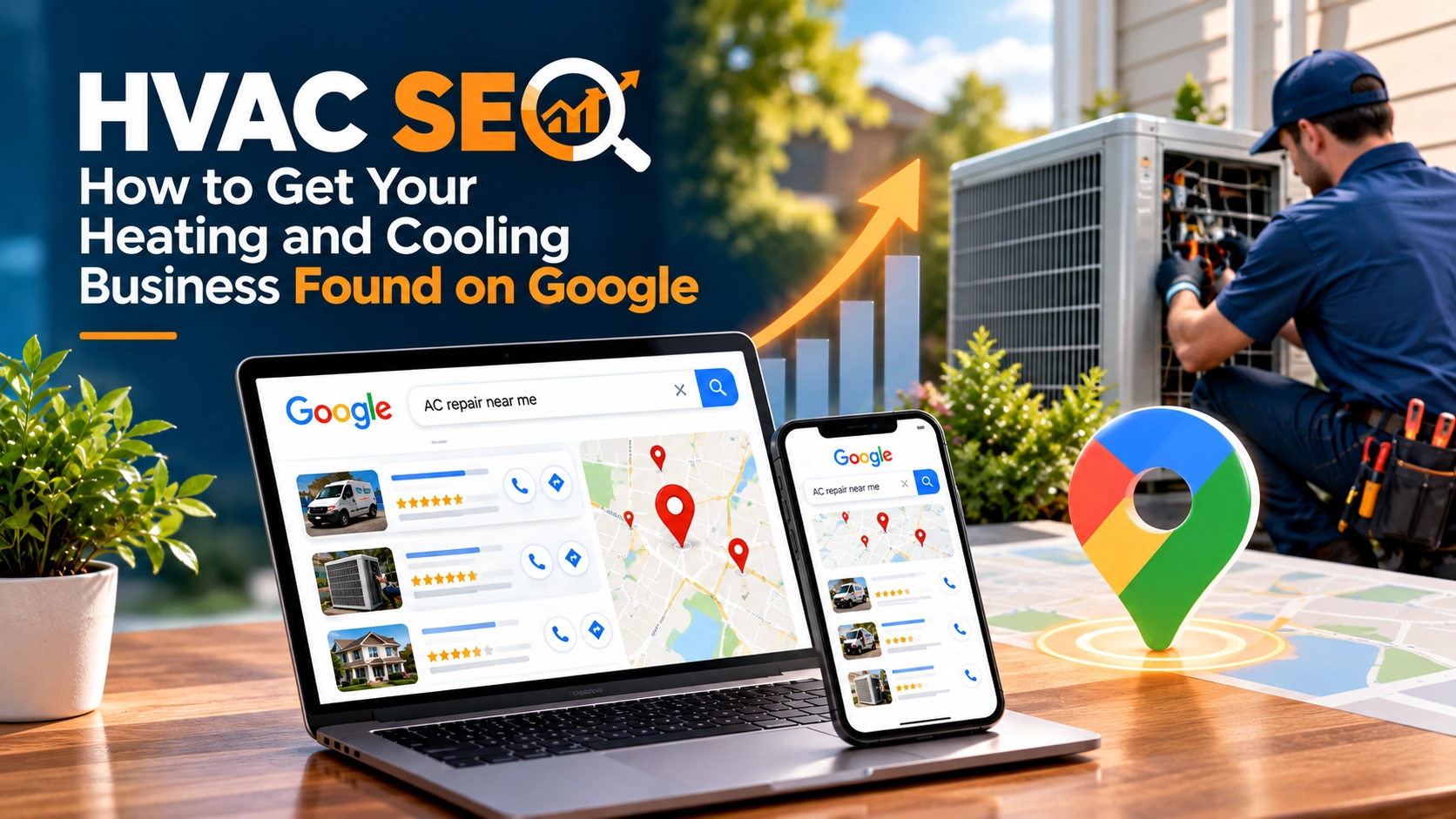
It is 6:30 on a hot July evening, and the upstairs of a home is 84 degrees. The AC is running, but the air coming out of the vents is warm. The homeowner picks up a phone, searches “AC repair near me,” checks the map results and a few websites, and calls one of the businesses they find.
That call goes to a company the homeowner found on Google. For most HVAC contractors, the question is not whether customers search online. It is whether your business shows up when they do.
HVAC SEO (search engine optimization for heating and cooling companies) is the work of making your website and local presence easier for Google to understand and easier for homeowners to choose. It covers your service pages, your Google Business Profile, local keywords, technical health, helpful content, reviews and the way you measure results.
One honest note: organic visibility builds over time. Google’s own SEO Starter Guide says there are no secrets that automatically rank a site first, and some changes take months to show. This guide covers what actually matters, whether you do the work yourself or hire help.
What Is HVAC SEO and Why Does It Matter?
SEO for an HVAC business means improving how your company appears in Google’s unpaid search results for the services customers need, such as “furnace repair near me” or “HVAC company near me.”
When someone searches for an HVAC service, they often see four different kinds of results:
- Local Services Ads often appear at the top for home service searches. They are paid ads, billed per lead rather than per click.
- Google Ads (search ads) are paid text ads, usually billed per click and labeled as sponsored.
- The local map results show nearby businesses from Google Business Profile, with a map, ratings and a call button.
- Organic results are the regular website listings below. You cannot pay to appear here.
SEO covers the last two: the local map results and the organic listings. Ads can work alongside SEO, but they are a separate channel with a separate budget, and they stop showing when you stop paying.
Many HVAC jobs start with an urgent search, and homeowners usually choose from the businesses they see first. Showing up for the right searches, in the towns you actually serve, gives you a fair shot at that call.
The goal is not just traffic. Twenty local homeowners who need a new furnace are worth more than a thousand visitors who will never hire you. Good HVAC SEO aims for qualified calls and inquiries from your service area.
1. Optimize Your Website for HVAC Services
Your website is where Google learns what you do. If every service is crammed onto one “Services” page, it is hard for Google, and for customers, to tell what you actually specialize in.
Most HVAC contractors benefit from a dedicated page for each core service they genuinely offer, for example:
- Air conditioning installation and replacement
- Heating system installation
- HVAC maintenance and tune-up plans
On each service page, cover the basics:
- A clear page title and H1, such as “Furnace Repair and Installation.”
- What the service includes, common warning signs and what happens after the call
- Your service area, so visitors know you come to them
- Links to related services and helpful articles
- A visible phone number and a clear call to action
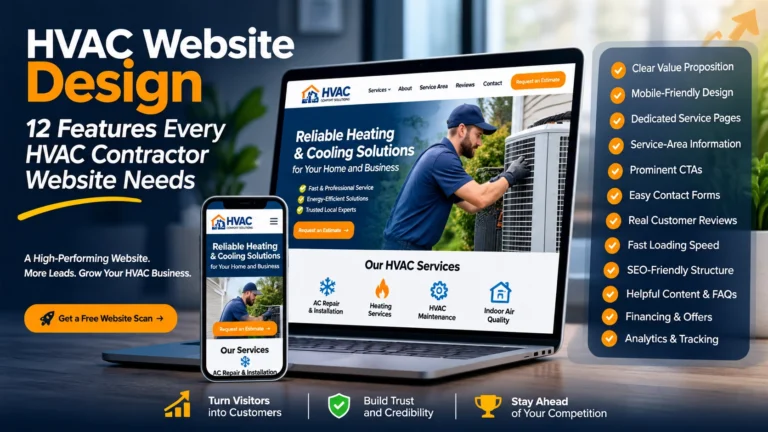
Do not create a separate page for every small keyword variation. “AC repair,” “air conditioner repair” and “AC fix” are the same need and belong on one strong page. If your site structure itself needs work, our HVAC website design page explains how service pages fit into a well-built site.
2. Improve Your Google Business Profile
Your Google Business Profile is what appears in the map results and on Google Maps. For many local searches, it is the first thing a homeowner sees about your company.
Google says local results are based mainly on three things: relevance (how well your profile matches the search), distance (how far you are from the searcher) and prominence (how well known your business is, including reviews and links). You cannot pay Google for a better local ranking.
To give your profile the best chance:
- Use your real business name exactly as it appears in the real world. Do not add extra service keywords, locations, or promotional phrases to the business name just to influence rankings.
- Set up your address correctly. If you serve customers at their homes and have no storefront they visit, set up a service-area business and hide your address. Virtual offices and P.O. boxes are not eligible.
- Choose accurate categories: a primary category such as HVAC contractor, plus only the extras that genuinely apply.
- Keep services, hours and service areas accurate, and match service areas to where you really work.
- Add real photos of your team, trucks and installations.
- Ask customers for honest reviews without screening only for customers you expect to be positive. Never offer incentives in exchange for reviews, and respond to feedback professionally.
- Keep one profile per business. Duplicates confuse Google and customers.
Optimization helps, but no profile is guaranteed a specific map position, and distance alone means you will rank differently across your service area. Our Google Business Profile page explains how we approach this for HVAC companies.
3. Target the Right Local HVAC Keywords
HVAC searches are local and specific. Homeowners often search for the service or problem they need, sometimes adding a nearby-location phrase. Examples include:
• AC repair near me
• Furnace repair near me
• HVAC installation services
• Emergency HVAC repair
• Heat pump installation
The key is search intent: what the searcher actually needs. Someone searching “emergency HVAC repair” wants a phone number and fast availability. Someone searching “heat pump vs furnace” is researching and wants an explanation. Match each page to one main intent, and do not try to make one page serve every type of search.
When choosing which keywords to focus on, weigh four things:
- Service relevance: do you actually offer it, and is it profitable for you?
- Geographic relevance: is it in the area you really serve?
- Competition: how strong are the businesses already ranking?
- Business priorities: would you rather book more replacements, maintenance plans or repair calls?
4. Create Useful HVAC Service-Area Pages
If you serve several towns, location pages can help customers in each area understand that you work there. They are worth building when you have something genuinely useful to say about each place.
A good service-area page includes:
- Unique details about the area, such as common home types or typical HVAC issues
- The services you actually offer there
- Real local project examples, when you have them
- Questions customers there often ask
- Accurate contact details and hours
- Links to the most relevant service pages
Do not create dozens of near-identical city pages by swapping the town name. Google’s spam policies describe pages that target specific cities and funnel users to one page as doorway abuse. Three genuinely useful pages beat ten thin ones.
A location page also does not produce rankings or leads on its own. It supports the rest of your local SEO, and our local SEO for HVAC companies service is built around exactly this balance.
5. Fix Technical SEO Problems
Google has to be able to find, access and understand a page before it can show that page in search results. Technical SEO is the work that makes sure nothing gets in the way. You do not need to be a developer to understand the basics:
- Mobile usability. Google mainly uses the mobile version of your site to index and rank it.
- Page speed. Compress large photos and remove plugins you no longer use.
- HTTPS. Every page should load securely.
- Crawlability and indexability. Important pages should not be blocked or accidentally set to “noindex.”
- XML sitemap. Lists your important pages so Google can crawl them efficiently. Submit it in Search Console.
- Robots.txt. Tells crawlers what to skip. It does not hide a page from Google; a noindex tag does that.
- Canonical tags. Tell Google which version of two very similar pages is the main one.
- Broken links and redirects. Redirect removed or renamed pages to the closest relevant page.
- Google Search Console. A free tool that shows indexing problems and the searches your site appears for.
- Structured data. Accurate LocalBusiness markup, where it applies, helps Google understand your business details.
Passing a speed test or fixing every warning does not guarantee better rankings. Technical health removes obstacles; your content, relevance and local reputation still do the heavy lifting.
6. Publish Helpful HVAC Content
Homeowners have questions long before they are ready to book. Helpful articles answer those questions, show that you know your trade, and give Google more reasons to see your site as relevant. Examples:
- Why Is My AC Running but Not Cooling?
- How Often Should an HVAC System Be Serviced?
- Furnace Repair vs. Replacement: What Should Homeowners Consider?
- Signs Your Air Conditioner May Need Professional Repair
- What to Know Before Installing a Heat Pump
Each article should connect naturally to a related service page. A post about an AC that runs but does not cool should link to your AC repair page, because that is where the reader may go next.
Two cautions. First, quality beats volume: Google’s helpful content guidance warns against pages made mainly to rank, and its spam policies cover mass-produced, low-value content. Second, keep advice safe. Explain what homeowners can check, such as a dirty filter or a tripped breaker, and leave refrigerant, gas and electrical work to licensed technicians.
7. Build Trust Through Reviews, Citations, and Relevant Backlinks
Google looks at how well known and trusted your business is, not just what your website says. Four things contribute, and each plays a different role:
- Genuine customer reviews help homeowners decide and are one of the prominence signals Google mentions for local ranking. Ask right after a job, with a direct review link.
- Consistent business information (name, address or service area, phone) across important directories prevents confusion.
- Relevant local and industry mentions, such as your chamber of commerce or a trade association, show you are established in the area.
- Editorially earned links from legitimate websites show that others consider you worth referencing.
Realistic ways to earn these:
- Ask equipment suppliers or manufacturers about dealer or contractor listings
- Sponsor local teams, school events or charity drives that publish sponsor links
- Join industry associations that list members
- Publish a genuinely useful local resource, such as a seasonal maintenance checklist for your climate
Avoid shortcuts. Google’s spam policies treat buying links for ranking as link spam, and the FTC’s 2024 rule bans fake reviews, including those from people who never used the business. No specific number of backlinks guarantees rankings.
You cannot improve what you do not measure. Start with these sources:
- Google Search Console: impressions (how often your site appeared), clicks, and the actual search queries and pages involved
- Organic landing pages: which pages bring in visitors from Google, and which lead to inquiries
- Google Business Profile performance: calls, website clicks and direction requests from your profile, where available
- Phone calls and form inquiries from your website
- Qualified leads and booked jobs, when you can reliably connect them to their source
Keep the difference between these clear:
- Rankings show where you appear for a given search.
- Traffic shows how many people visited.
- Leads show how many contacted you.
- Business outcomes show how many became paying jobs.
Rising impressions with no calls usually point to a problem on the page, not an SEO problem. Results depend on your starting point, competition, market and the quality of the work, so judge progress over months, not days.
Common HVAC SEO Mistakes to Avoid
- Targeting broad keywords without local relevance. Visibility for a broad term such as “HVAC” alone may not attract qualified customers in the areas your business actually serves.
- One page for every service.
- Thin, duplicate city pages with only the town name changed.
- An inaccurate Google Business Profile, such as wrong hours, phone number or category.
- Generic AI-written content that could apply to any trade in any city.
- Ignoring mobile visitors, so the phone number is hard to find on a phone.
- Tracking rankings but not calls and qualified inquiries.
- Expecting guaranteed first-page rankings. No one can honestly promise them.
How Long Does HVAC SEO Take to Show Results?
There is no universal timeline. Google itself notes that some changes take effect within hours while others can take several months. How long your results take depends on:
- The current state of your website and Google Business Profile
- How competitive your market is
- The size of your service area
- Your site’s existing authority and reputation
- How many technical issues need fixing first
- How consistently the work is done
Separate early signs from business results. Early signs include pages getting indexed and more impressions in Search Console. The result that matters, more qualified calls and booked jobs, usually takes longer.
Be cautious of anyone promising first-page rankings in 30, 60 or 90 days. Steady, measurable progress is the realistic goal.
Should You Hire an HVAC SEO Agency?
Many contractors handle the basics themselves, such as keeping their Google Business Profile current and asking for reviews. Professional help makes sense when:
- You do not have time to work on SEO consistently during busy seasons
- Your site has technical problems you are not sure how to fix
- You serve multiple towns or counties and need a clear local strategy
- You cannot tell which marketing activities are producing calls
If you do hire help, look for a provider that offers:
- A clear audit, with priorities in order
- Keyword and competitor research for your actual service area
- Transparent on-page and technical work
- A realistic local SEO strategy, with no fake addresses or spam
- Content planning tied to your real services
- Reporting on calls and inquiries, not just rankings
- Clear communication and measurable objectives
Be wary of guaranteed rankings, secret methods or contracts you cannot understand.
HVAC Marketing USA works only with heating and cooling contractors, so the strategy is built around HVAC services, seasonality and service areas from the start. If you would like specialist support, you can see how we approach HVAC SEO services for contractors.
Frequently Asked Questions About HVAC SEO
What is HVAC SEO?
HVAC SEO is the process of improving a heating and cooling company’s website and local presence so it appears more often in Google’s unpaid search and map results for the services and areas it covers.
How can an HVAC company rank higher on Google?
Build a clear page for each core service, keep your Google Business Profile accurate and active, target local service-and-city searches, fix technical problems, publish genuinely helpful content, and earn real reviews and links. Then track calls, not just rankings, and keep improving.
Is Google Business Profile important for HVAC contractors?
Yes. It powers your appearance in the local map results and on Google Maps, which is where many homeowners compare HVAC companies. Accurate details, real photos and genuine reviews all help, although no profile is guaranteed a specific position.
How much do HVAC SEO services cost?
It depends on your market, how competitive it is, the number of locations or service areas, the condition of your current site and how much work is included each month. Be careful comparing quotes on price alone; compare the scope. You can see our own plans on our Pricing page.
Can a small HVAC company compete with larger companies on Google?
Often, yes, especially in local results, where distance and relevance matter and not just company size. A small contractor with focused service pages, an accurate profile, strong reviews and genuine local content can compete well within its own service area.
Is HVAC SEO better than paid advertising?
Neither is better in every situation. Paid ads, including Local Services Ads, can bring calls quickly but stop when the budget stops. SEO takes longer to build but keeps working without paying for each click or lead. Many HVAC companies use both: ads for immediate demand, SEO for long-term visibility.
Get More Visibility for Your HVAC Business
Getting found on Google is not one trick. It is a technically sound website, a clear page for every core service, an accurate Google Business Profile, useful local content, genuine reviews and honest measurement, all working together over time.
If you would like a second opinion, HVAC Marketing USA works only with HVAC contractors and can review your current setup and show you what we would prioritize.
Want to understand how your HVAC website is performing in search?
Request a Free SEO Scan from HVAC Marketing USA.
Implementation note: Make “Request a Free SEO Scan” a clearly visible clickable button or link to the existing contact page: https://hvacmarketingagencyusa.com/contact/ . Do not leave it as plain, non-clickable text.