A homeowner’s AC quits on a 95-degree afternoon. They grab their phone, search for help, and open three or four contractor websites in a row. One loads slowly and buries the phone number. Another lists “HVAC services” without saying which towns it covers. The third makes everything obvious in a few seconds. That third company usually gets the call.
That is the real job of HVAC website design. A contractor website is not a digital business card with a logo, a services list and a phone number. It should help a visitor understand, quickly and without effort:
- What services you provide
- Why your company is a reasonable choice
- How to request service or an estimate
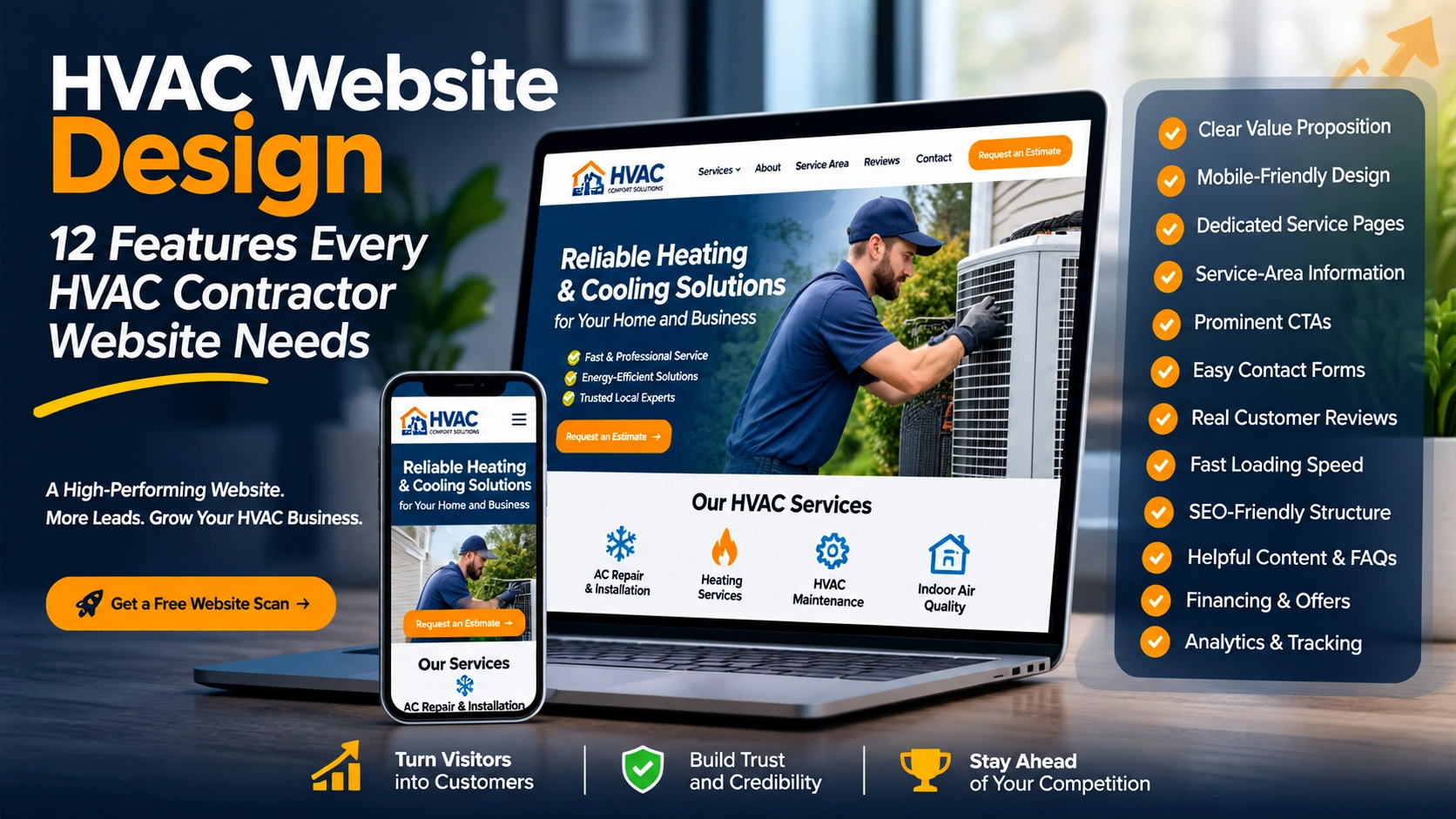
A well-built site supports four things at once: trust, usability, search visibility and conversions. Below are 12 features that do that work. None of them is a magic switch for rankings or leads, but together they give your website a fair chance to earn both.
Why HVAC Website Design Matters
For most homeowners, your website is where they decide whether to call. They may find you through Google Search, the Map Pack, a referral or a truck wrap, but they usually check your site before picking up the phone.
Here is what your website affects:
- First impressions and trust. An outdated site raises doubts about your work, while real reviews and clear company details give a stranger reasons to let you into their home.
- Mobile usability. Many HVAC searches happen on a phone, and Google uses the mobile version of a site for indexing and ranking.
- Service discovery and local visibility. Clear service and location pages help homeowners and search engines understand what you do and where.
- Calls and decisions. Homeowners compare companies quickly. The site that answers their questions and makes the next step obvious has the advantage.
An attractive website looks good in a screenshot. An effective one gets a worried homeowner from “my furnace is making a strange noise” to “I booked a technician” with as little friction as possible. Aim for both, but when you have to choose, choose effective.
Is Your HVAC Website Ready for Today’s Customers? See how your current site holds up on mobile, speed and clarity. Request a free website scan and get a practical list of what to fix first.
12 Essential Features Every HVAC Contractor Website Needs
1. A Clear Homepage With a Strong Value Proposition
Your homepage has a few seconds to answer the basics. Above the fold, a visitor should see:
- Your primary services (heating, cooling, or both; residential, commercial, or both)
- The next step, usually a phone number and a request button
Compare two headlines. “Welcome to Our Website” says nothing. “Heating and Cooling Repair, Installation and Maintenance for Homes in Your Service Area tells the visitor what you do and where, before they scroll. (This is an illustrative example, not a real company’s wording.)
2. Mobile-Friendly and Responsive Design
A homeowner standing next to a silent furnace is not on a desktop. Your website has to work just as well on a phone and a tablet as on a laptop, and Google uses the mobile version of your content for indexing and ranking.
A mobile-friendly HVAC website has:
- Text that is readable without zooming
- A simple menu that opens and closes easily
- Buttons large enough to tap with a thumb
- A click-to-call phone number that stays visible
- Forms that are easy to fill on a small screen
- Service information that is not hidden in tiny tabs
Quick mobile test (do it on your own phone):
- Open your homepage. Can you find the phone number without scrolling?
- Tap it. Does it start a call?
- Open the menu and find a specific service, such as AC repair.
- Fill out your contact form completely. Was anything awkward?
- Turn the phone sideways. Does the layout still work?
- Try it on a slow connection, away from Wi-Fi. Does the page load quickly?
3. Clear HVAC Service Pages
One generic “Services” page that lists everything in a paragraph is hard for customers to use and gives search engines little to work with. Most contractors benefit from a dedicated page for each core service they actually offer, such as:
- AC repair, installation and replacement
- Furnace repair and installation
- HVAC maintenance and tune-ups
Your structure should match your business. If you do not install ductless systems, do not build a ductless page.
A useful service page explains what the service includes, common signs a homeowner needs it, which areas you cover, what happens after they call, and answers to a few common questions. That depth helps the reader decide, and it gives search engines a clear page to show for that specific search.
Homeowners want to know one thing quickly: do you come to my neighborhood? Make that easy.
- Add a clear service-area section listing the cities, towns or counties you cover.
- Keep your business name, address and phone number accurate and consistent across your site and your Google Business Profile.
- Create location pages where you have real coverage and something useful to say, such as local housing types, climate concerns or the services most requested in that area.
- Link location pages to the relevant service pages, and the other way around.
A warning: do not create dozens of nearly identical city pages with only the town name swapped. Google’s spam policies call out pages built to target specific cities or regions that funnel users to one page as doorway abuse. Build location pages that genuinely help someone in that area. If you want help with this, our local SEO for HVAC companies service covers it.
5. Prominent Calls to Action
Every page should make the next step obvious. Common HVAC calls to action include:
Where to place them:
- Homepage: in the hero section and again near the bottom
- Service pages: near the top and after the main content
- Mobile: a sticky call button or a call button in the header
- Contact section: a short form plus the phone number
Match your calls to action to how you actually work. If you do not offer online scheduling, do not show a “Book Online” button. If you answer the phone 24/7, say so clearly. If you do not, set honest expectations.
A long, confusing form loses requests. Keep it short and clear:
- Ask only for what you need to respond
- Use clear labels, not placeholder text that disappears when typing starts
- Make fields easy to complete on mobile
- Show a helpful confirmation message that says when you will respond
- Test that every submission actually reaches your inbox or CRM
- Use a secure (HTTPS) site and do not ask for sensitive personal information you do not need
Example of a practical HVAC estimate request form:
- ZIP code or service address
- Service needed (dropdown: repair, installation or replacement, maintenance, other)
- System type (optional: AC, furnace, heat pump, not sure)
- Short description of the issue
- Preferred contact time (optional)
That is enough to call back with a useful answer. Ask for anything else later in the conversation.
7. Real Customer Reviews and Trust Signals
Inviting a stranger into your home is a big decision. Trust signals help homeowners make it with confidence. Strong HVAC websites show:
- Authentic testimonials from real customers, used with permission
- Links to verified reviews on Google or other review platforms
- Licenses and certifications, where they apply in your state
- Manufacturer dealer status, if you hold it
- Years in business, stated accurately
- Real photos of your team, trucks and work
- Clear contact details and a physical service address where appropriate
Never fabricate testimonials, star ratings, awards, licenses or business history. Beyond the obvious trust damage, the U.S. Federal Trade Commission finalized a rule in 2024 that bans fake reviews and testimonials, including those attributed to people who do not exist or who never used the business.
If you add review structured data, follow Google’s guidelines: a business that controls reviews about itself is not eligible for star review rich results through LocalBusiness or Organization markup.
A slow site wastes the moment a homeowner is ready to act. Performance should be measured, not judged by how the site feels on your office Wi-Fi.
Common causes and fixes:
- Images: compress them, size them correctly, and use modern formats such as WebP
- Scripts: remove plugins and code you no longer use
- Third-party tools: chat widgets, tracking pixels and embedded feeds add weight, so keep only what earns its place
- Mobile: test on a real phone and on a cellular connection, not only on a desktop
Google’s Core Web Vitals measure real-world experience with three metrics: Largest Contentful Paint (loading, good at 2.5 seconds or less), Interaction to Next Paint (responsiveness, good at under 200 milliseconds) and Cumulative Layout Shift (visual stability, good at under 0.1). Google recommends achieving good scores, but they are not a guarantee of higher rankings. Use PageSpeed Insights and the Core Web Vitals report in Google Search Console to track them, and focus on steady improvement rather than chasing a perfect score.
9. SEO-Friendly Website Structure
A good-looking site that search engines cannot understand will struggle to be found. The foundations every HVAC website should have:
- Descriptive page titles that say what the page is about, such as “AC Repair and Installation”
- Unique meta descriptions that summarize each page (Google may still write its own snippet from the page content)
- One H1 per page, with logical H2 and H3 headings beneath it
- Clean URLs like /ac-repair/ rather than /page?id=123
- Internal links between related services, locations and helpful articles
- An XML sitemap submitted in Google Search Console
- Crawlability and indexability: important pages are not blocked or set to noindex by mistake
- Canonical tags where similar pages exist
- Relevant structured data, such as LocalBusiness and FAQ markup, used accurately
- Descriptive image alt text that explains what the image shows
These are foundations, not guarantees. Technical compliance makes it possible to rank; relevance, helpful content, local signals and competition decide how well. Ongoing HVAC SEO is how most contractors build on this base.
10. Helpful Content and Frequently Asked Questions
Homeowners have questions before they call. Answering them on your site builds trust and saves your team time on the phone. Examples:
- What is included in an AC tune-up?
- When should an HVAC system be replaced instead of repaired?
- How often should a furnace or heat pump be serviced?
- What is the difference between a heat pump and an air conditioner?
- Which HVAC services does your company provide, and where?
Add short FAQs to service pages where they fit, and write longer articles for bigger questions such as repair-versus-replace decisions. Each piece should answer a real question your customers ask. Publishing repetitive articles just to add volume does not help readers and can dilute your site.
11. Financing, Promotions and Maintenance Plans, Where Applicable
A replacement system is a major purchase, so clear information about how customers can pay or save helps them decide. If your business genuinely offers them, your website can explain:
- Financing options and how to apply
- Maintenance plans and what they include
- Seasonal promotions with clear terms and end dates
- Service agreements for commercial clients
- Warranty information on parts and labor
Only show offers you actually provide, and keep the terms accurate and current. An expired promotion or a vague financing claim creates more distrust than having no offer at all. Never invent discounts or financing terms to make a page look stronger.
12. Analytics and Conversion Tracking
Without measurement, you are guessing which pages and channels bring in work. At a minimum, set up Google Search Console and Google Analytics to understand:
- Overall website traffic and where it comes from
- Which landing pages people arrive on
- Organic search visibility: which searches show your site, and which pages appear
- Clicks on your phone number
- Estimate and service requests
- Other conversion events that matter to your business
Keep one distinction in mind: a click on your phone number is not a completed call. Analytics records the tap, not whether the call connected or became a job. Call tracking and your booking records fill that gap, and even then no setup captures everything, so use the data to spot trends.
Common HVAC Website Design Mistakes to Avoid
Most underperforming HVAC websites share a handful of problems:
- A desktop-first layout that breaks on phones
- Vague or copy-paste service descriptions
- A phone number hidden on the contact page
- Confusing navigation with too many menu items
- Huge images that slow every page down
- No service area anywhere on the site
- Fake, unverifiable or years-old reviews
- Broken forms, near-duplicate city pages, or pages with no clear next step
If you spot three or more of these on your own site, it is worth a closer look.
Should You Redesign Your Existing HVAC Website?
Not every site that underperforms needs to be rebuilt. Signs a redesign may be worth considering:
- It is hard to use on a phone
- Visitors struggle to find services or contact details
- The design looks dated next to local competitors
- Core services have no dedicated pages
- There is no clear path from a page to a call or a request
- Technical SEO issues keep coming back, such as slow pages, indexing problems or broken links
- Company information, services or service areas are out of date
- Your team cannot easily update photos, promotions or content
If only one or two apply, targeted fixes are often enough: compressing images, adding service pages, rewriting the homepage headline or fixing the contact form. A full rebuild makes sense when the problems are structural, such as a platform you cannot edit. A good HVAC website redesign keeps the content and rankings worth keeping and redirects old URLs properly.
Find Out What Your HVAC Website Could Improve. We will review your site’s design, mobile usability, page structure, SEO foundations and conversion paths, then send a practical list of what we would fix first. Request a free website scan.
HVAC Website Design Checklist
Use this checklist to assess your current site. Each “no” is a place to start.
☐ Our homepage says what we do, where we work and how to contact us on the first screen
☐ The site is easy to read and use on a phone
☐ The phone number is visible and tappable on every page
☐ Each core service we offer has its own detailed page
☐ Our service area is clear, and location pages contain genuinely local information
☐ Every page has a clear call to action that matches how we take jobs
☐ Our contact form is short, works on mobile, and every submission reaches us
☐ Reviews, licenses and offers shown are real and current
☐ Pages load quickly on a phone using cellular data
☐ Each page has a unique title and meta description, and related pages link to each other
☐ Our XML sitemap is submitted in Google Search Console
☐ We track form submissions and phone clicks, and review the data regularly
Frequently Asked Questions
What should an HVAC contractor website include?
At minimum: a clear homepage, a dedicated page for each core service, service-area information, a visible phone number with click-to-call, a short contact or estimate form, genuine reviews and credentials, fast mobile performance, solid SEO basics, and analytics to measure calls and form submissions.
How much does HVAC website design cost?
It depends on page count, custom design, integrations such as booking or financing tools, content writing, and whether hosting and support are included. You can see our current packages on the Pricing page.
How long does it take to build an HVAC website?
It depends on the size of the site, how ready your content and photos are, any integrations, and how quickly revisions are approved. Ask for a timeline based on your specific scope.
Does HVAC website design affect SEO?
Yes. Site structure, mobile usability, page speed, content quality, internal linking and crawlability all influence how easily search engines can understand and rank your pages. Good design does not guarantee rankings, but a poorly built site makes ranking much harder.
Should HVAC contractors have separate service pages?
In most cases, yes, for each core service you actually offer. Separate pages let you explain each service properly and give search engines a clear page for each search. Each page should contain distinct, useful information, not the same text with a different service name.
Can an HVAC website help generate leads?
It can support them. Clear service information, trust signals and easy contact options make visitors more likely to call or submit a request. Lead volume still depends on your traffic, market and reputation, so no website can guarantee a specific number.
How often should an HVAC website be updated?
Whenever your services, service areas, hours or offers change. Beyond that, review it a few times a year for outdated content, broken links, speed issues and new customer questions worth answering.
Final Thoughts: Build an HVAC Website Around Your Customers
An effective HVAC website is not about flashy design. It combines clear messaging, easy mobile use, useful service and location content, solid technical foundations, real trust signals and an obvious path to contact you. Each of the 12 features plays a part in getting a homeowner from search to booked service.
Start with the checklist above. Score your current site honestly, fix the biggest gaps first, and improve from there.
Ready for a Better HVAC Website? If your website no longer reflects the quality of your HVAC business, let’s discuss what could be improved. Get a free website scan or request a quote for your next project.